
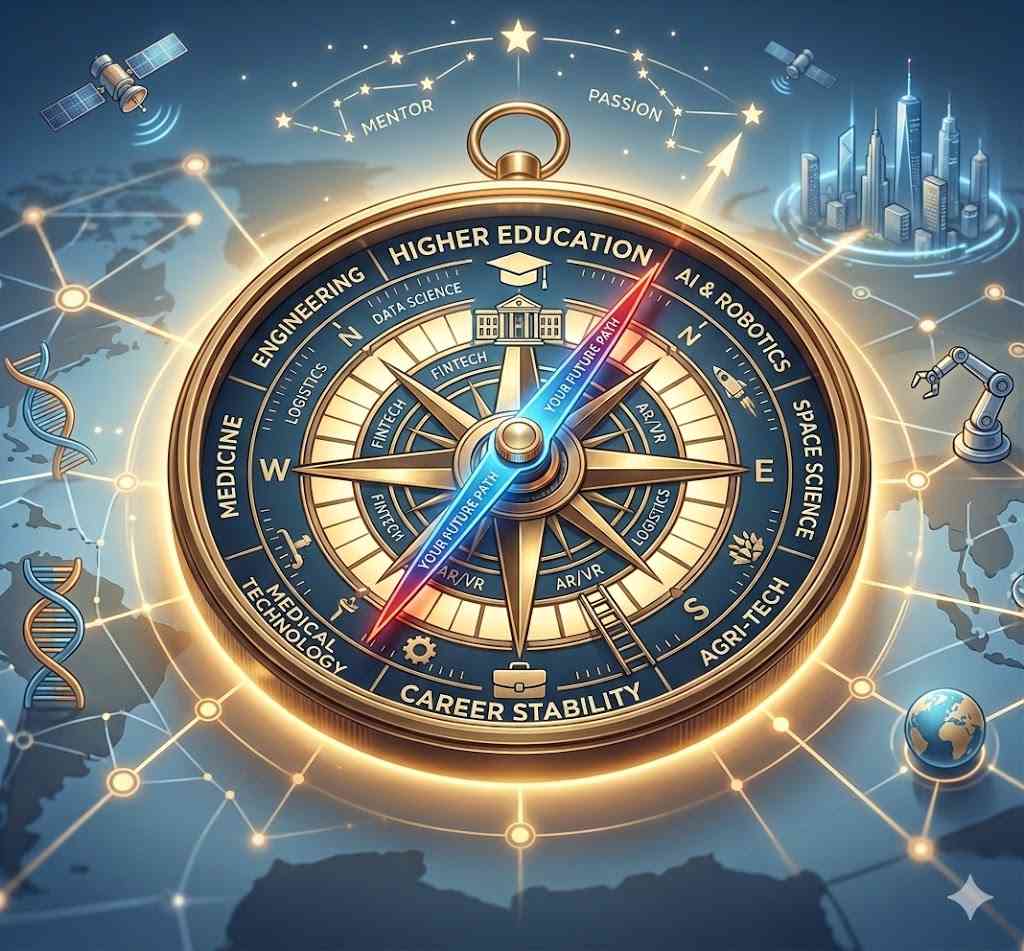
The Future of Engineering: Beyond the Traditional Blueprint
Engineering has always been the backbone of human progress, and its importance will only grow. However, the “safe” specializations of the past are evolving. To build a stable and enjoyable career today, you must look where foundational engineering meets Artificial Intelligence.
Where the Demand is Shifting
While the laws of physics remain constant, the tools and applications have changed. At Guide2Career.com, we help you navigate these emerging high-growth sectors:
- AI & Data-Driven Engineering: Moving beyond manual calculations to systems that learn. This includes Predictive Maintenance and Generative Design, where AI helps engineers create structures more efficient than ever before.
- Robotics & Autonomous Systems: From factory floors to surgical suites, the future belongs to engineers who can build and manage machines that “think” and navigate the physical world independently.
- Space Science & Exploration: With the expansion of the global space economy, aerospace engineering is no longer just for government agencies—it’s a booming private sector for satellite networks and deep-space tech.
- Modern Agriculture (Agri-Tech): Engineering is the key to global food security. The industry is desperate for experts in Automated Transportation, smart irrigation, and robotic harvesting.
- Automated Transportation: The shift to electric and autonomous vehicles is creating a massive vacuum for engineers who understand power electronics, sensor fusion, and AI-driven safety protocols.
Emerging Frontiers in Health & Healing
At Guide2Career.com, we help students look beyond the traditional stethoscope to discover high-demand, stable roles in the new medical landscape:
- AI-Enhanced Diagnostics: Be the bridge between data and a cure. New roles are emerging for specialists who use AI to detect diseases like cancer or rare genetic disorders years before symptoms even appear.
- Robotic Surgery & Intervention: The surgeon of the future is a high-tech pilot. We guide students toward specializations in Robotic-Assisted Surgery, where precision is measured in microns and recovery times are slashed.
- AI Health Advisors & Preventive Care: The focus is shifting from hospitals to “Smart Health.” There is a booming market for advisors who use wearable data and AI to manage patient health in real-time, preventing illness before it starts.
- Bioinformatics & Digital Twins: Using AI to create a “Digital Twin” of a patient to test drug reactions safely in a virtual environment. This allied health field is critical for the future of personalized medicine.
- Medical AI Ethics & Governance: As machines begin to suggest diagnoses, the world needs medical professionals who understand the legal and ethical frameworks of AI-human collaboration.
The Media Revolution: From Storytelling to World-Building
The era of traditional broadcasting and linear content is being replaced by a new, interactive reality. In 2026, being “creative” isn’t enough—you must be a Spatial Storyteller. As AI, AR, and VR move from the fringe to the core of global entertainment, the most successful careers will be found at the intersection of human imagination and immersive technology.
Emerging Frontiers in Digital Expression
At Guide2Career.com, we help students navigate the high-growth roles where “making art” meets “making reality”:
- Immersive Experience Developers (AR/VR/XR): Beyond gaming, these creators are building the “Metaverse”—virtual worlds for concerts, education, and global fan gatherings. They specialize in spatial computing and real-time rendering using engines like Unity and Unreal.
- Generative AI Content Designers: Traditional graphic design and video editing are evolving. The new leaders are “Creative Engineers” who use AI to generate real-time dialogue, dynamic storylines that change based on viewer reactions, and complex VFX in a fraction of the time.
- Virtual Production Specialists: Replacing physical sets with LED “Volumes” and digital twins. This role allows filmmakers and actors to interact with 360-degree digital environments in real-time, drastically reducing the need for costly location shoots.
- AI-Driven Audience Insights Analysts: Media is no longer a guessing game. These professionals use predictive AI to analyze global viewing habits, ensuring content is hyper-personalized and delivered exactly when and where the audience wants it.
- Ethical AI Content Moderators: As synthetic media and deepfakes proliferate, the industry needs “Truth Architects”—professionals who use technical skill and ethical judgment to verify media and protect public trust.